
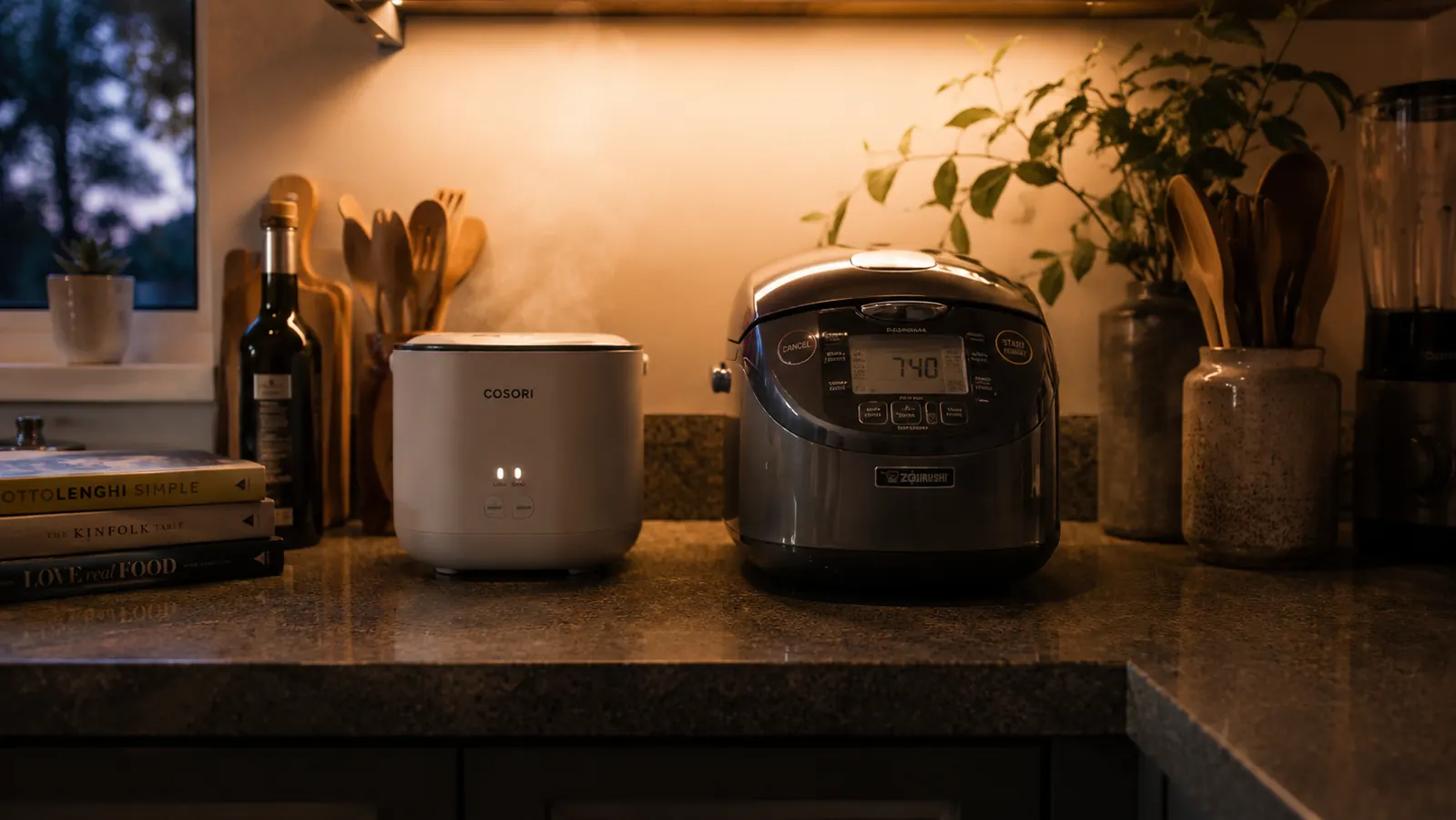
When my rice needs shrank down to cooking for one, most nights, I didn't need the six-cup workhorse my mother used for a family of five. I needed something that would sit on twelve inches of open counter, cook two cups without scorching, and not become one more pot I had to wash by hand at eleven at night. That's the decision in front of anyone comparing the DASH Mini Rice Cooker against an Aroma rice cooker: buy small and precise, or buy bigger and more flexible. I've used the DASH daily for months and ran an Aroma alongside it for three weeks to see where each one actually earns its keep. Short answer: if you're cooking for one or two, the DASH wins on counter space and simplicity. If you're feeding a household or batch cooking rice for the week, the Aroma's extra capacity is worth the larger footprint.
For this comparison I used the DASH Mini Rice Cooker, the 2-cup version with the removable ceramic nonstick pot, against an Aroma 6-cup digital rice cooker, the simple one-touch model most people mean when they say an Aroma rice cooker. Neither is the flagship version of its brand. Both are the models that show up first in search results, and the ones most people actually buy. That felt like the fair fight, and it's the comparison I'd want if I were choosing between them myself. If you want the full write-up on the DASH alone, I covered six months of daily use with it here.
| What Matters | DASH Mini Rice Cooker | Aroma 6-Cup Rice Cooker |
|---|---|---|
| Cost | Lower, one of the least expensive rice cookers sold | Moderately higher, roughly double the DASH |
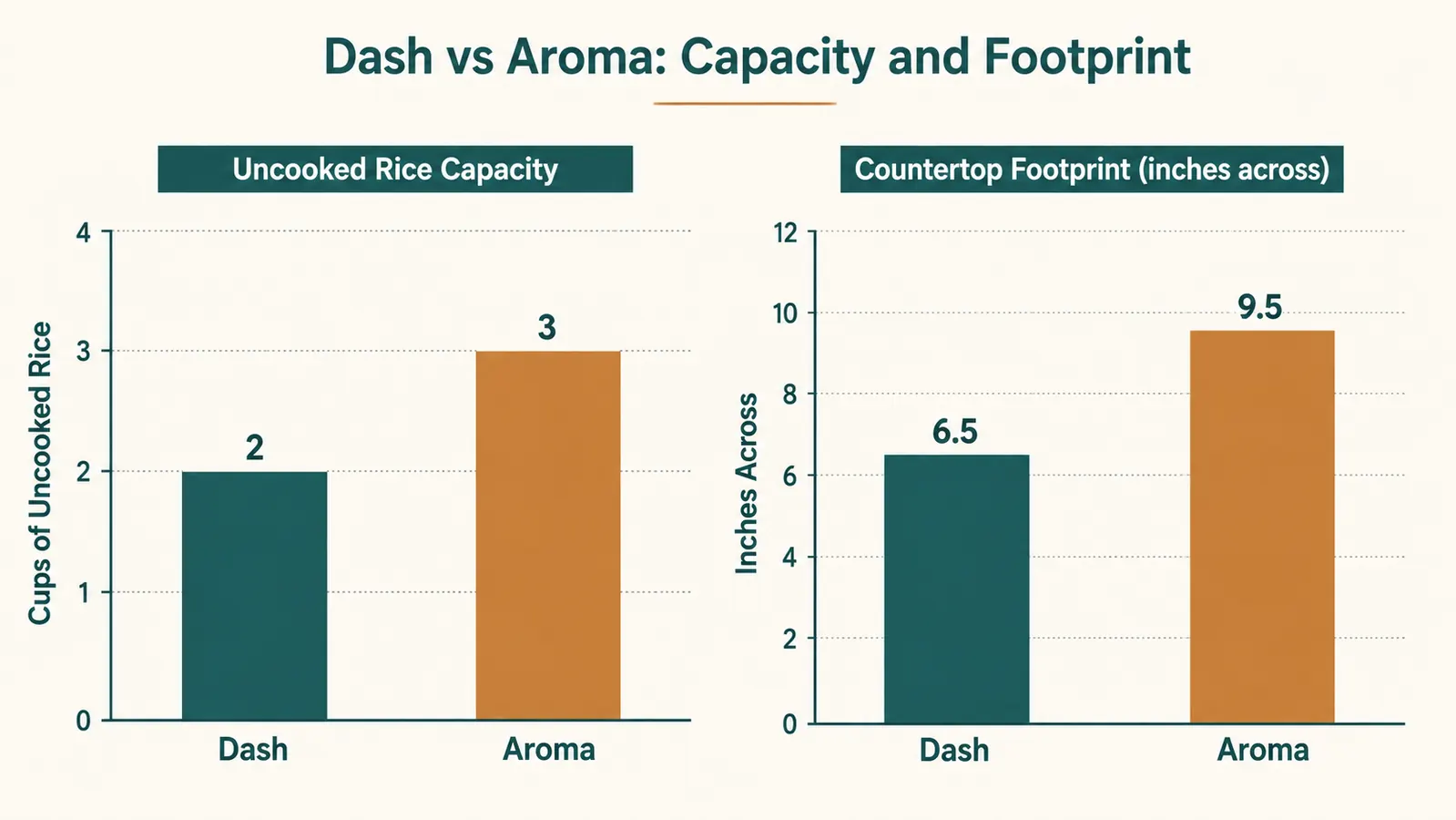
| Capacity | 2 cups uncooked, about 4 cups cooked, built for 1 to 2 servings | 3 cups uncooked, about 6 cups cooked, built for 3 to 4 servings |
| Pot Material | Removable ceramic nonstick bowl | Removable nonstick-coated aluminum pot |
| Countertop Footprint | About the size of a large mug, roughly 6.5 inches across | Roughly 9.5 inches across, needs a dedicated spot |
| Cook Settings | One-button cook and keep-warm, no extra modes | Cook and steam function plus keep-warm |
| Cleanup | Removable pot and lid, small surface area, dishwasher safe | Removable pot, dishwasher safe, larger surface to scrub |
| Warranty | 1-year limited manufacturer warranty, registered with a receipt | 1-year limited manufacturer warranty, registered through Aroma's site |
Cooking for one or two? The DASH cooks a real serving of rice without babysitting the stove.
Two cups of rice, one button, and a pot small enough to tuck behind the toaster when you're done.
Amazon Check Today's Price on Amazon →Where the DASH Wins
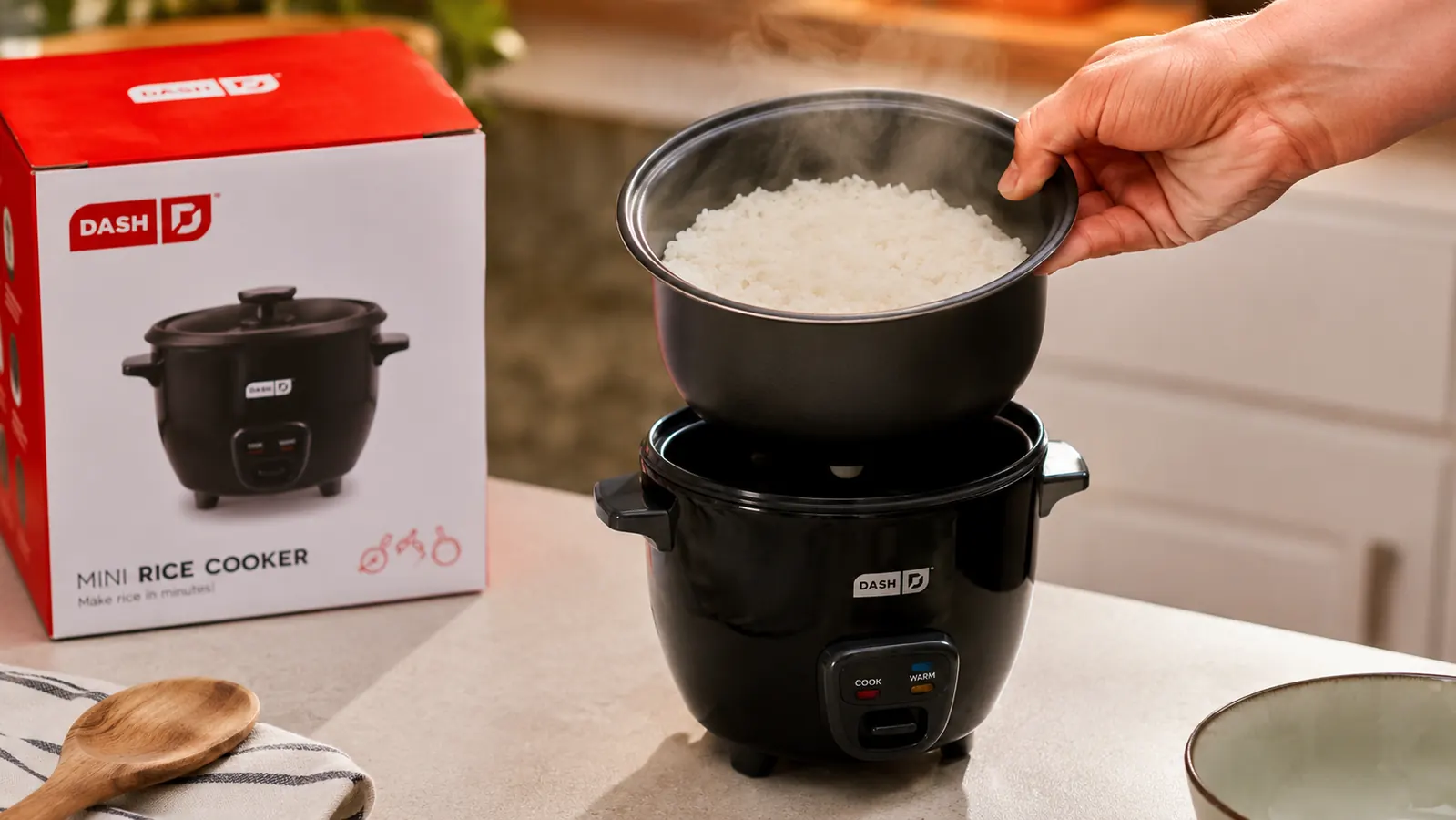
The DASH's biggest advantage isn't a feature, it's restraint. A 2-cup pot means I'm not staring at three days of leftover rice in the fridge because the cooker doesn't know how to make less than a full pot. I measure out what I'm actually eating that night, drop it in, press the one button, and walk away. The ceramic pot is light enough to lift out with one hand, rinse under the tap, and set in the drying rack in under a minute. There's no lid gasket to pick apart, no steam vent to unscrew and scrub. When I'm cooking dinner after a long day, the DASH is the appliance I don't have to think about.
Size is the other real win. The DASH takes up about as much counter space as a coffee mug and a saucer stacked together. In a kitchen where the counter runs out before the ambition does, that's not a small thing. I keep mine in the cabinet next to the toaster and it's out and plugged in inside of ten seconds. The Aroma, by comparison, needs a permanent spot. It's not heavy, but its footprint is close to half again as wide as the DASH's, and pulling a bigger appliance out of a cabinet every night is exactly the kind of friction that gets a rice cooker abandoned. I go into more of the small-kitchen math in this piece on counter space.
Where the Aroma Wins
The Aroma's win is capacity, and it's not a small one. Three cups of uncooked rice turns into roughly six cups cooked, enough for a family of four with leftovers, or enough to batch cook rice for the week in one run. The DASH physically cannot do that. Push more than 2 cups of uncooked rice into it and you'll get scorching on the bottom and undercooked grains near the top, because the pot and the heating element were sized together for a small batch. If you're cooking for more than two people on a regular basis, the DASH will leave you running it twice, and that erases most of its speed advantage.
The Aroma also gives you a steam function, which the DASH doesn't have. Drop a tray of vegetables over the rice while it cooks and dinner finishes as one unit instead of two. It's not a sophisticated steam mode, no presets for different vegetables, but it works, and it means the Aroma pulls double duty as a side-dish appliance in a way the DASH was never built to do. If your cooking style leans toward one-pot dinners for a full table, that steam tray closes a real gap.
The DASH is a rice cooker sized for the way I actually eat, one plate at a time. The Aroma is sized for the way most families eat, several plates at once. Neither is wrong. They're just built for different counters.
Texture and Consistency: What I Actually Tasted
Rice cookers get judged on convenience, but texture is where cheap models usually fall apart. I ran the same jasmine rice, same rinse count, same water ratio through both machines side by side. The DASH's ceramic pot produced rice that was slightly drier and more separated, grain by grain, which I actually prefer for fried rice the next day. The Aroma's larger pot ran a touch stickier, closer to what you'd get from a rice cooker built for sushi rice or short-grain varieties. Neither result is bad. It's a difference in how the heat distributes across a small versus a larger cooking surface.
Where the two diverge more is at the edges of their capacity range. Cook a scant half cup of rice in the Aroma and it runs the risk of cooking unevenly, because the heating element is calibrated for a bigger minimum load. Cook a heaping 2 cups in the DASH and you're at the edge of what the pot can hold without the keep-warm cycle drying out the top layer. Stay inside each machine's intended range and both perform well. Push either one past its designed capacity and the results get noticeably worse.
Footprint and Storage: What Fits in a Small Kitchen
I measured both units before deciding anything. The DASH's footprint is roughly 6.5 inches across, about the same real estate as a large coffee mug. The Aroma runs closer to 9.5 inches across and taller, which is the difference between fitting in a single cabinet shelf gap and needing its own dedicated spot on the counter or a lower shelf you have to bend for. If your kitchen has a drawer or a cabinet shelf with a few spare inches, the DASH slots in without a fight. If you've got a pantry shelf or counter real estate to spare, the Aroma's size stops being a problem.
Cord storage matters more than people expect too. The DASH's cord is short, which I like, because a long cord dangling off the counter edge is how cords end up frayed at the plug. The Aroma's cord runs longer to accommodate being plugged in from a fixed spot on the counter. Neither is objectively better, it depends on where the appliance lives. Mine lives in a cabinet, so a short cord that doesn't tangle with everything else stored nearby is worth more to me than reach. I wrote about my full daily routine with the DASH, warts included, in this honest review, and the step-by-step version of how I actually run it is in this guide.
Timing: Which One Fits an Unpredictable Schedule
My dinner hour moves around more than I'd like to admit. Some nights I'm cooking at six, some nights it's closer to nine, and a rice cooker that demands advance planning doesn't survive long on my counter. The DASH's short cycle for a 2-cup batch runs in roughly 20 to 25 minutes, which means I can decide to eat rice fifteen minutes before I'm actually hungry and still make it work. The keep-warm function holds it at a reasonable temperature for an hour or two if my schedule slips further, without the bottom layer turning into a crust. For a kitchen where dinner time is a moving target, that short cycle matters more than any other spec on the box.
The Aroma runs a longer cycle simply because there's more rice to cook, closer to 35 to 45 minutes for a full 3-cup batch. That's not a flaw, it's the tradeoff for capacity, but it does mean the Aroma rewards a bit more planning. If you know dinner is at a set time, or you're cooking rice in the morning to have ready for the week, the longer cycle is a non-issue. If your schedule is genuinely unpredictable and you're deciding what's for dinner twenty minutes before you eat it, the DASH's shorter run time and smaller minimum batch make it the easier habit to keep.
Long-Term Reliability: What Wears Out First
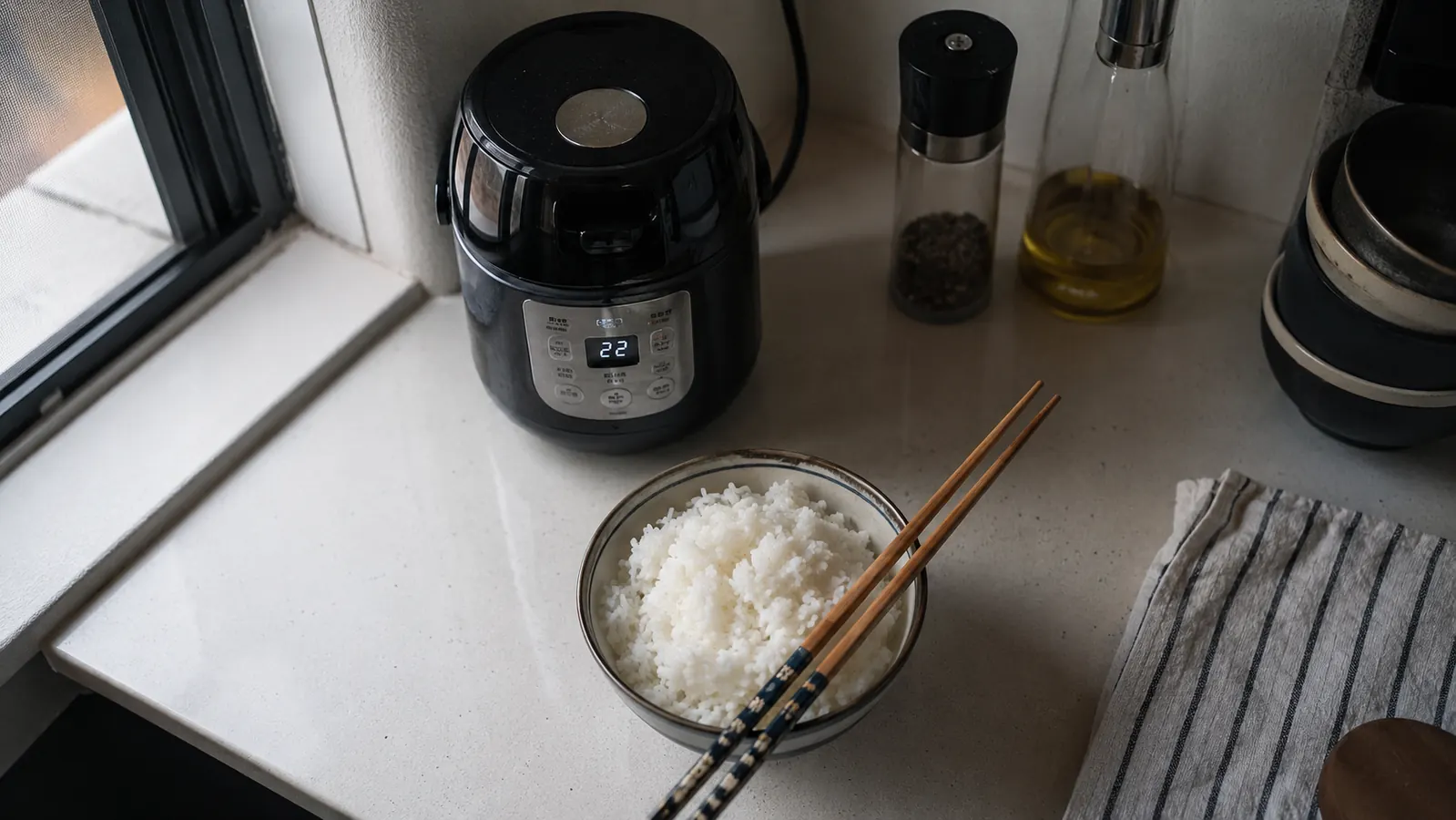
Nonstick coatings are the part of any rice cooker that fails first, so that's what I watched closest over months of daily use. The DASH's ceramic pot has held its nonstick surface well with a plastic spatula only rule and a hand wash instead of the dishwasher's harsher heat, though I've read enough owner complaints to know that dishwasher cycles do shorten ceramic coating life faster than hand washing does. Scratches from metal utensils are the other common failure point, and they'll happen just as easily in a small pot as a large one. The rule is the same regardless of which cooker you buy: no metal spoons, no abrasive scrubbing, and the coating lasts years instead of months.
The Aroma's nonstick aluminum pot faces the same coating risk but across a larger surface, which in practice means more area where a stray metal utensil or a rough sponge can do damage. Both brands back their cookers with the same one-year limited warranty, so neither has a structural edge on paper if something fails early. What I've noticed in practice is that the smaller DASH pot is easier to inspect and easier to be careful with, simply because there's less of it to keep track of. A bigger pot means more surface for wear to accumulate unnoticed until you're scraping rice off a spot that used to release cleanly.
Who Should Buy Which
Buy the DASH if you're cooking for one or two people most nights, if your counter space is already spoken for, and if you want an appliance you press once and forget about. Buy the Aroma if you're feeding three or more people regularly, if you batch cook rice for the week, or if the steam function replacing a second pot matters to your routine. I ended up keeping the DASH on my counter and the Aroma in a box in the closet for the two times a year I cook for a crowd. Your ratio of solo nights to crowd nights should decide it for you. If you want the longer story of how the DASH ended up being the one I reach for, I told it in full in this piece.
Small kitchen, small batches: the DASH is built for exactly that.
One button, one pot, cooked in about the time it takes to set the table. Check today's price and see if it's in stock.
Amazon Check Today's Price on Amazon →