
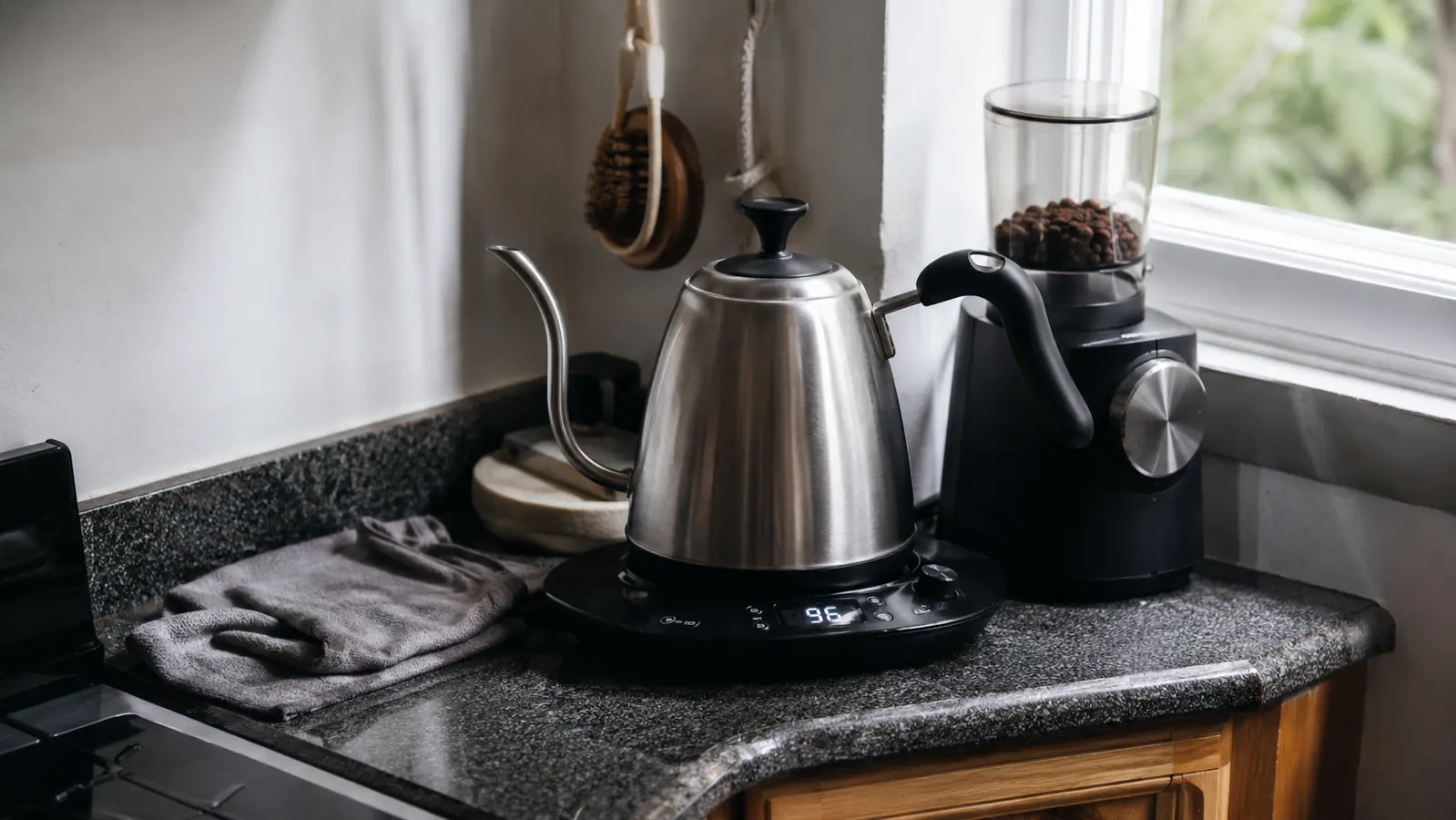
I bought the Willow & Everett gooseneck kettle in February, on the same day I gave up trying to make good pour-over coffee with a stovetop kettle that had no idea what temperature it was pouring at. I'd ruined enough good coffee beans guessing at when the water sounded right that I finally looked up why my pour-overs tasted flat no matter how carefully I measured the grounds. The answer, it turned out, was water at a rolling boil scorching the coffee before it ever had a chance to bloom properly. Six months later, after pouring coffee out of this kettle most mornings whether I got up at six or closer to nine, this is what actually held up and what I still work around.
I picked the 0.8 liter size on purpose. My kitchen has one stretch of counter next to the stove, already crowded with a coffee grinder and a dish rack that never fully empties, and I wasn't going to add a full-size kettle to it for coffee I mostly make for myself. The Willow & Everett kettle's footprint is small enough that it lives on that counter permanently now, plugged in next to the grinder, which matters more than it sounds like it would when you're deciding whether a new gadget earns a permanent spot or ends up in a cabinet after the second week.
The Quick Verdict
A precise, small-footprint gooseneck kettle that fixed the actual problem with my pour-over coffee, temperature control, and held up through six months of daily use, though hard water buildup and the fixed presets are real tradeoffs worth knowing about first.
Amazon Check Today's Price →Tired of guessing at water temperature and scorching good coffee beans?
See today's price and current availability for the Willow & Everett gooseneck kettle on Amazon before you decide.
Amazon Check Today's Price on Amazon →How I've Used It
This wasn't a kettle I tested for two weeks and then wrote up while the results were still fresh. I've used it almost every morning since February, pour-over on workdays, French press on the rare weekend I have the patience for it, and green tea most evenings once the weather turned warm enough that I stopped wanting coffee after three in the afternoon. None of that is glamorous, it's just what actually happened to this kettle across six months of a schedule that doesn't run on a fixed clock.
The routine settled into the same shape most days: fill it to somewhere around two cups, pick a temperature preset, and let it heat while I grind beans and set up the dripper. That's the whole workflow, and the reason it stuck is that the kettle does the one thing a basic electric kettle can't, which is stop heating at a specific number instead of just boiling until I remember to unplug it.
I also started using it for oatmeal water and the occasional mug of hot water with lemon and honey when I felt something coming on. It's not marketed for either of those, but a kettle that heats water to an exact number fast enough to use on a weekday morning ends up doing more jobs than the one you bought it for.
Weekdays and weekends ended up looking different too. On workdays the kettle is on and off in under two minutes, water heated to 205°F while I'm still grinding beans, poured, and unplugged again before I've had time to think about it. Weekends are slower, a French press at 208°F with the keep-warm option running while I actually sit down instead of eating standing at the counter, which is a small thing, but it's the difference between a routine and an actual morning.
Temperature Control After Six Months of Actual Use
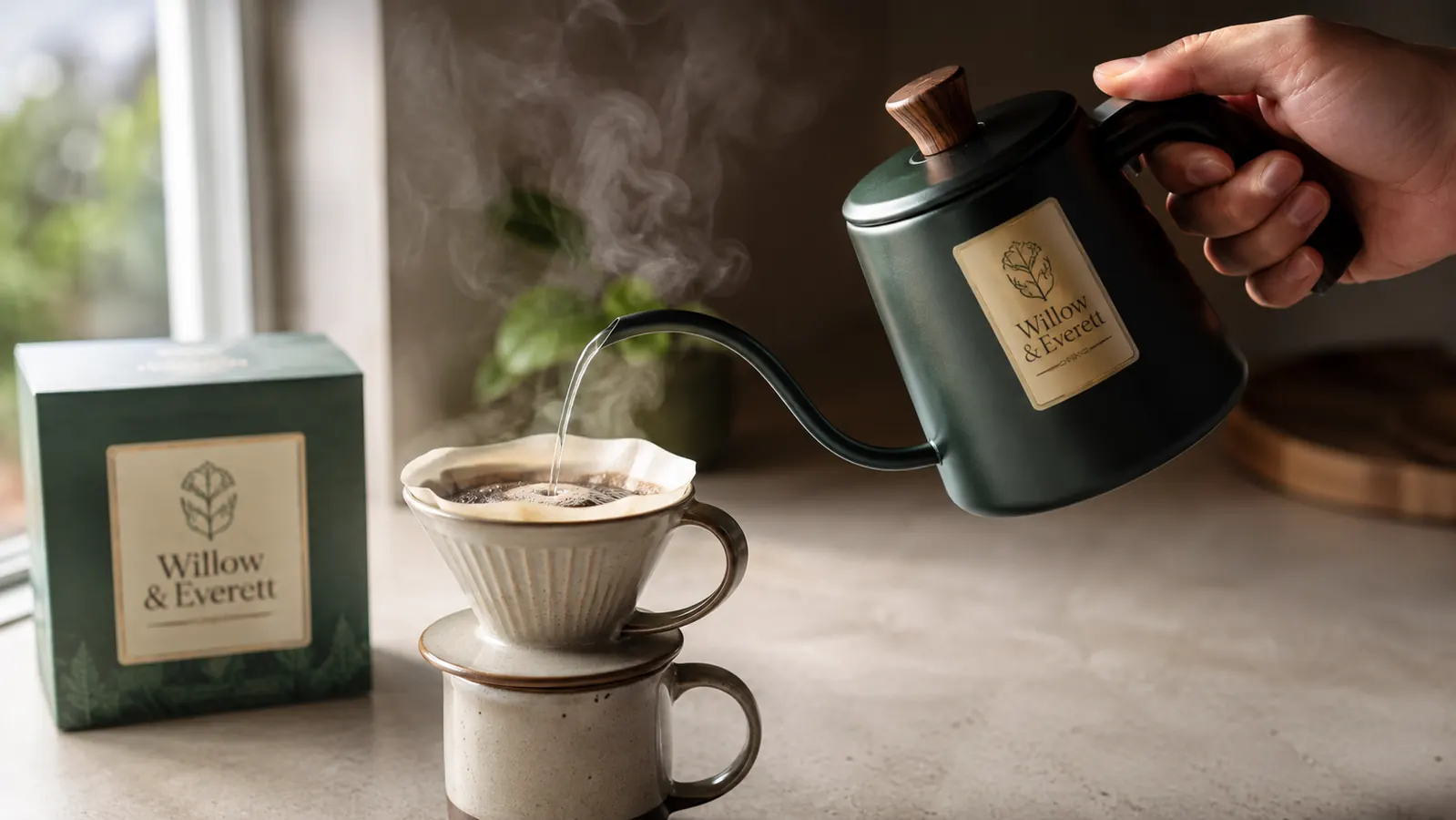
The whole reason I bought a gooseneck kettle with temperature presets instead of a cheaper basic model was to stop guessing, and that's the part that's held up the best. The Willow & Everett kettle has preset buttons I've come to rely on without thinking, 175°F for green tea, 195°F for a darker roast pour-over, 205°F for a lighter roast, and 208°F for French press, close enough to boiling to fully extract without scorching anything. I didn't verify the presets against a lab thermometer, but I did check the 205°F setting against a basic instant-read thermometer a few times in the first month, and it landed within two or three degrees each time, close enough that I stopped double-checking after that.
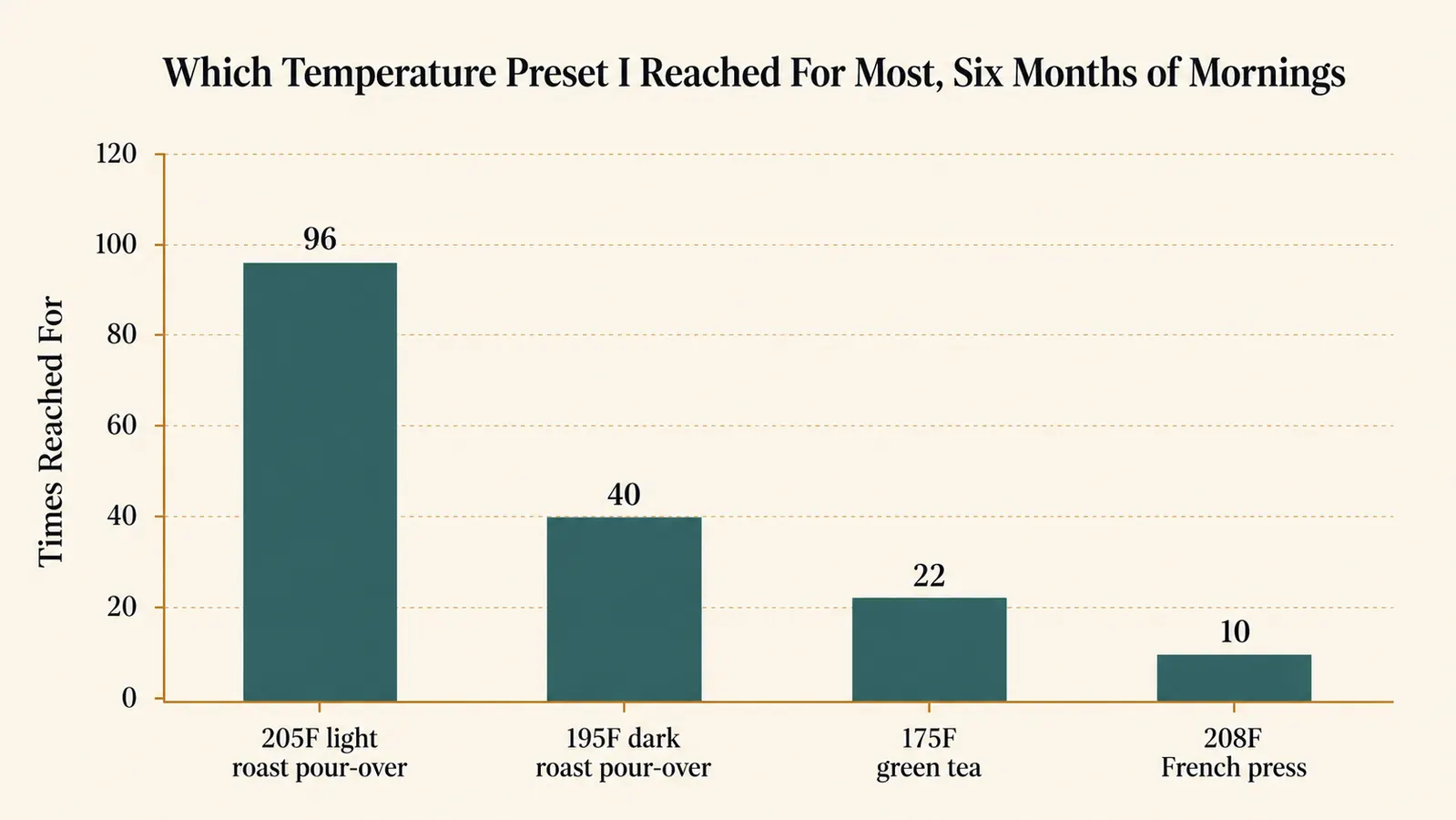
Over six months, I ended up reaching for 205°F far more than any other setting, which makes sense since that's my daily pour-over temperature. I tracked it loosely for about a month out of curiosity more than anything, and the pattern held for the rest of the six months: the light roast setting got used more than every other preset combined.
Where the temperature control actually changed my coffee, not just the process, was consistency. Before this kettle, my pour-overs varied a lot from one morning to the next depending on how long I let the water sit after it came off the stove. Now every cup starts at the same number, and the flat, slightly burnt taste that used to show up on mornings when I poured too fast and too hot has mostly disappeared.
The display and buttons are simple enough that I've never had to think about them, which matters more than it sounds like it should first thing in the morning. There's no app, no bluetooth pairing, and no software to update, just four preset buttons and a start button, and every one of them still responds the same way it did on day one. I've bumped the base reaching for a mug half-asleep more times than I'd like to admit, and nothing about the control panel has ever misfired or needed a reset because of it.
The Gooseneck Spout and Build Quality Over Time
The gooseneck spout is the other half of what this kettle is actually for, and it's easy to underestimate how much it matters until you've poured from a wide-mouth kettle and watched water come out in an uncontrollable rush instead of a thin, steady stream. Six months in, the spout still pours exactly the way it did the first week, a slow, controllable stream I can start and stop mid-pour without water splashing over the sides of the dripper.
The stainless steel body has held up fine with the exception of the base, where hard water in my area has left a faint ring of mineral buildup around the heating element that a vinegar rinse mostly clears but never fully removes. It's cosmetic, not functional, the kettle still heats to temperature at the same speed it did in February, but if you have hard water, expect to see that same ring eventually and plan on a vinegar descale every month or so instead of never.
The handle and the base, which is BPA-free plastic rather than all stainless steel, are the parts I was most skeptical about buying a kettle for coffee, and they've been fine. The handle hasn't loosened, the base hasn't cracked or discolored from six months of daily heat cycles, and the kettle still detaches cleanly from its base the way it did on day one. I'd have preferred an all-metal build, mostly out of habit from owning cheaper appliances that didn't last, but nothing about the plastic has actually failed.
The Keep-Warm Function and What It's Actually Good For
The keep-warm option sounded like a feature I wouldn't use much, and for the first month I mostly ignored it. It's turned out to be the setting that matters most on the mornings that don't go according to plan, the ones where I start heating water and then get pulled away by something else for ten minutes. Instead of reheating from scratch or pouring water that's dropped ten degrees, the kettle holds the last temperature I set for a while, long enough that I can walk back to a kitchen where the water is still where I left it.
It's not a warming function you'd want to leave running for hours, and I haven't tried to. But for the ten or fifteen minute gaps that happen on an unpredictable schedule, a morning that runs long or a call that starts right when I meant to be pouring coffee, it's saved more cups than I expected a single button to save.
Speed, Noise, and the Small Daily Frictions
Speed was the other thing I wasn't sure about going in, since gooseneck kettles have a reputation for being slower than a basic kettle because of the narrower spout and body. In practice, a full 0.8 liters gets to 205°F in a little under four minutes on my counter, which is fast enough that it's rarely the bottleneck in my morning, the grinder and the dripper setup take about as long as the water does to heat.
Noise is the one thing nobody mentions until you own an electric kettle in a small space where sound carries. This one isn't silent, it has an audible hum while heating and a soft click when it reaches the preset temperature, but it's quieter than the stovetop kettle it replaced, which used to whistle loud enough to wake anyone still asleep down the hall. The cord is long enough to reach the one outlet near my counter without an extension, which sounds minor until you've had to plan a kitchen appliance around cord length before.
What I Considered Before Buying
Before I bought an electric gooseneck kettle at all, I looked hard at just buying a cheaper stovetop gooseneck kettle and using a separate thermometer to check the water by hand. I actually tried that first, borrowing a stovetop kettle from a friend for a couple of weeks, and wrote up the full side-by-side in my electric versus stovetop gooseneck kettle comparison, which covers the actual pour control and wait-time differences in more detail than fits here.
I also almost talked myself out of spending money on a coffee gadget at all, since I'd already ruined enough pour-overs to wonder if the problem was me and not the kettle. I wrote about how that decision actually played out in the story of the kettle that fixed my bitter pour-over coffee, which is the more personal version of the same six months.
What I Liked
- Temperature presets held within a couple degrees of accurate through six months of daily use
- Gooseneck spout still pours the same slow, controllable stream it did on day one
- Keep-warm function has saved cups on mornings that got interrupted
- Small enough footprint to live permanently on a crowded counter
- The 205°F preset alone has covered most daily pour-over coffee without any guessing
Where It Falls Short
- Hard water leaves a mineral ring around the base that needs a monthly vinegar rinse
- 0.8 liter capacity means refilling if you're making more than two cups or a full French press
- The plastic base feels less durable than an all-stainless build, even though it hasn't actually failed
- No way to fine-tune temperature beyond the presets if you want something outside 175 to 208 degrees
I didn't buy this kettle to become a coffee person. I bought it to stop wasting good beans on water I couldn't control, and six months later that's still the only thing that's actually changed.
Who This Is For
If you make pour-over coffee or tea regularly and you're tired of guessing at water temperature with a basic kettle, the Willow & Everett kettle earns its spot on a small counter. It's built for someone who wants one gadget that fixes a specific daily annoyance, not someone assembling a full barista setup. I laid out the fuller case in this list of reasons a gooseneck kettle upgrades your morning coffee, if you want the shorter version of everything six months taught me.
Who Should Skip It
If you're making coffee or tea for a full household every morning, the 0.8 liter capacity will have you refilling and reheating more than you'd like, and a larger kettle makes more sense. If you already have a reliable way of checking water temperature and don't mind the extra step, a basic kettle and a cheap thermometer will get you most of the way there for less money. If a hum during heating is going to bother anyone sleeping nearby, that's worth weighing too, since this kettle isn't silent even if it's quieter than a stovetop whistle. For the sharper complaints I didn't spend as much time on here, I wrote a more unfiltered version in my honest review of the Willow & Everett kettle after daily use.
If scorched, inconsistent pour-overs have worn you out, this is what fixed it
Check today's price on the Willow & Everett gooseneck kettle and see if it's in stock for your kitchen.
Amazon Check Today's Price on Amazon →